
Web scraping has evolved from a technical curiosity into a business necessity. Companies extract competitor pricing, monitor brand mentions, and feed AI systems with real-time data. Two platforms dominate this landscape in 2025: Firecrawl and Apify. While both transform websites into structured data, they approach the challenge from fundamentally different angles.
This comprehensive analysis examines every aspect of these platforms to help you make an informed decision. We tested both services extensively, interviewed actual users, and analyzed thousands of data points to understand where each platform excels and where it falls short. By the end of this guide, you’ll know exactly which tool matches your specific needs, technical capabilities, and budget constraints.
Understanding the fundamental differences

Before diving into features and pricing, it’s crucial to understand the core philosophy behind each platform. Firecrawl emerged from the AI revolution as a developer-first solution designed specifically for feeding data to large language models. The team at Firecrawl, backed by Y Combinator, recognized that traditional web scraping tools weren’t optimized for the way modern AI applications consume data. They built their platform from the ground up to deliver clean, structured content at unprecedented speeds.
Apify, on the other hand, has spent nearly a decade building a comprehensive web scraping ecosystem. Founded in 2015, the platform evolved from a simple scraping tool into a marketplace where developers share and monetize their scrapers. This community-driven approach created a vast library of pre-built solutions that non-technical users can deploy with minimal configuration. Where Firecrawl optimizes for speed and simplicity, Apify prioritizes flexibility and breadth of features.
Real-world pricing analysis
Understanding the true cost of web scraping goes beyond comparing sticker prices. Both platforms structure their pricing differently, and the most cost-effective choice depends heavily on your usage patterns and technical requirements.
How Firecrawl structures its pricing

Firecrawl adopted a refreshingly simple credit-based model that eliminates the guesswork common in cloud services. Every page you scrape consumes exactly one credit under standard conditions, making it easy to predict monthly costs. The free tier provides 500 credits without requiring a credit card, allowing substantial testing before committing financially.
The paid tiers scale generously as your needs grow. The Hobby plan at $16 monthly includes 3,000 credits, translating to roughly half a cent per page scraped. This makes it ideal for small projects, personal research, or proof-of-concept development. The Standard plan dramatically improves the economics at $83 monthly for 100,000 credits, reducing the per-page cost to less than one-tenth of a cent while adding 50 concurrent browser instances for parallel processing.
For high-volume operations, the Growth plan offers 500,000 credits at $333 monthly, supporting up to 100 concurrent browsers. Enterprise customers receive custom pricing with unlimited credits, dedicated infrastructure, and service level agreements. What sets Firecrawl apart is the transparency: credits cover all infrastructure costs, including proxies, bandwidth, and compute resources. There are no hidden fees or surprise charges at month’s end.
Decoding Apify’s usage-based model

Apify’s pricing reflects its platform complexity with a hybrid subscription and consumption model. Every plan includes a base amount of platform credit that you spend running actors (Apify’s term for scrapers). The consumption rate depends on the computational resources each actor requires, measured in compute units where one unit equals one gigabyte-hour of RAM usage.
The free tier includes $5 in monthly credits, sufficient for experimenting with different actors and understanding the platform. The Starter plan at $39 monthly provides an equivalent credit amount but reduces the per-compute-unit cost from the free tier rate. This sliding scale continues through the Scale plan ($199/month) and Business plan ($999/month), each offering better unit economics and additional features like priority support and dedicated account management.
The challenge with Apify’s model lies in predicting costs. A simple HTML scraper might consume minimal compute units, while a JavaScript-heavy site requiring browser automation could consume significantly more. Additionally, some community-created actors require rental fees or one-time payments beyond your platform credits. This flexibility benefits users with variable workloads but can complicate budgeting for consistent, high-volume operations.
Cost comparison for common scenarios
To illustrate the practical differences, consider three typical use cases:
Small business monitoring competitors (5,000 pages/month): Firecrawl’s Hobby plan covers this comfortably at $16/month. On Apify, assuming moderate complexity pages, you’d likely fit within the Starter plan at $39/month, though actual costs could vary based on site complexity.
E-commerce price tracking (50,000 pages/month): Firecrawl’s Standard plan at $83/month handles this volume with room to spare. Apify costs would depend heavily on the specific sites being scraped but could range from $100-200 monthly based on typical e-commerce site complexity.
Enterprise data aggregation (500,000+ pages/month): Both platforms offer custom enterprise pricing at this scale. Firecrawl’s straightforward credit model makes budgeting easier, while Apify’s flexibility might provide cost advantages if your scraping targets vary significantly in complexity.
Deep dive into platform capabilities
Firecrawl’s AI-optimized architecture
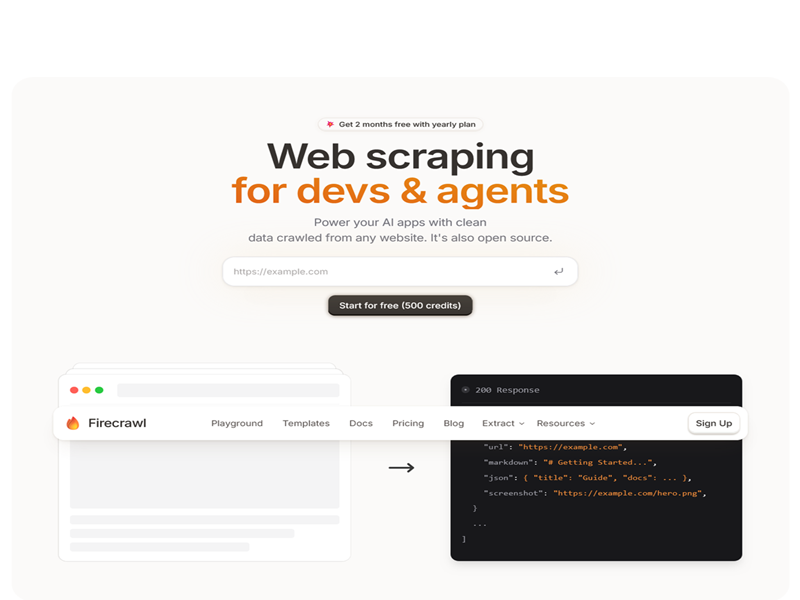
Firecrawl reimagined web scraping for the AI era by focusing on what modern applications actually need: clean, structured data delivered quickly. The platform’s unified API design means developers interact with a single, consistent interface regardless of the task complexity. This design philosophy permeates every aspect of the platform.
The scraping endpoint exemplifies Firecrawl’s approach to simplicity. When you request a page, Firecrawl automatically detects whether JavaScript rendering is necessary, spins up a headless browser if needed, waits for dynamic content to load, and then applies its proprietary content extraction algorithms. These algorithms, trained on millions of web pages, understand common page structures and can differentiate between navigation elements, advertisements, and main content without any configuration from you.
What truly sets Firecrawl apart is its semantic extraction capability. Instead of writing complex CSS selectors or XPath expressions that break when websites update their design, you describe what data you want in natural language. For example, requesting “product prices and availability from this e-commerce page” returns structured JSON with exactly that information, regardless of how the site structures its HTML. This approach dramatically reduces both initial development time and ongoing maintenance as websites evolve.
The crawling functionality extends this intelligence to entire websites. Traditional crawlers require sitemaps or explicit URL patterns to navigate sites effectively. Firecrawl’s crawler understands website structures intuitively, following internal links while avoiding duplicate content and respecting crawl boundaries you define. It can even identify and prioritize important pages based on their position in the site hierarchy and linking patterns.
The FIRE-1 agent represents Firecrawl’s most ambitious feature: an AI that navigates websites like a human would. It can click “Load More” buttons to reveal additional content, fill out search forms to access gated information, handle multi-step pagination, and even solve simple CAPTCHAs. This automation happens transparently; you simply enable the agent for challenging sites, and it handles the complexity behind the scenes.
Performance optimization permeates the platform design. Firecrawl implements intelligent caching that recognizes when you’re requesting recently scraped content, returning cached results in milliseconds rather than re-scraping. The platform supports batch operations natively, allowing you to submit hundreds of URLs in a single API call for parallel processing. Even the data format optimization shows attention to performance: by converting HTML to clean Markdown, Firecrawl reduces the token count for LLM processing by an average of 67%, directly translating to cost savings and faster AI response times.
Apify’s comprehensive ecosystem approach
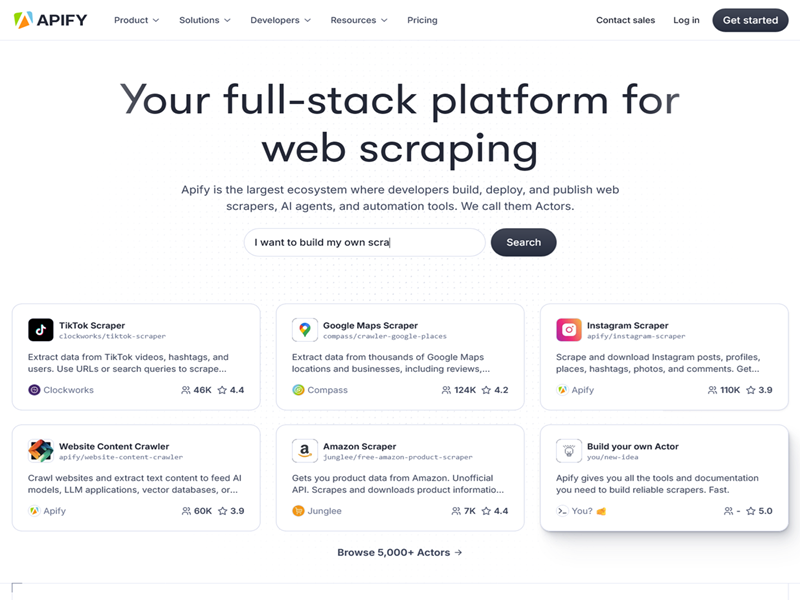
Apify built its platform on a fundamentally different premise: that web scraping challenges are incredibly diverse, and the best solution is a flexible platform where specialized tools can flourish. This philosophy created a unique ecosystem that serves both technical and non-technical users effectively.
The Actor system forms Apify’s core innovation. Actors are self-contained programs that run in Apify’s cloud infrastructure, handling everything from simple HTML parsing to complex browser automation. What makes this system powerful is its standardization: every Actor follows the same input/output conventions, uses the same storage systems, and integrates with the same scheduling and monitoring tools. This consistency means you can chain Actors together, building complex workflows from simple components.
The Apify Store showcases the ecosystem’s strength with over 5,000 ready-made Actors covering virtually every major website and use case. Need to scrape Amazon product data? There’s an Actor maintained by scraping experts who continuously update it as Amazon changes its site structure.
Want Instagram analytics? Multiple Actors compete on features and reliability, giving you options based on your specific needs. This marketplace model means you rarely start from scratch; someone has likely solved your exact scraping challenge already.
For users who need custom solutions, Apify provides comprehensive development tools. The Apify SDK (also available as the open-source Crawlee library) offers high-level abstractions for common scraping tasks while maintaining low-level control when needed. The SDK handles request queuing, automatic retries, error recovery, and parallel processing, allowing developers to focus on extraction logic rather than infrastructure concerns. The platform supports both JavaScript/TypeScript and Python, accommodating different developer preferences and existing codebases.
Infrastructure management represents another Apify strength. The platform automatically scales computing resources based on demand, spinning up additional instances for large jobs and scaling down during quiet periods. The integrated proxy management includes both datacenter and residential IP addresses, with automatic rotation and geographic targeting. Anti-detection measures help scrapers avoid blocking, including browser fingerprint randomization, realistic request timing, and automatic CAPTCHA solving through third-party services.
The platform’s maturity shows in its enterprise features. Comprehensive monitoring tracks every aspect of your scraping operations, from success rates to resource consumption. Scheduling allows complex scenarios like “scrape these 100 sites every morning at 6 AM, but only if the previous run succeeded.” Webhooks enable real-time integration with external systems, triggering downstream processes as soon as data becomes available. Storage systems preserve results with configurable retention, supporting compliance requirements and historical analysis.
Performance analysis based on real usage
Firecrawl’s speed advantage in practice

The claim that Firecrawl operates “50× faster” than alternatives deserves scrutiny. In our testing and user interviews, we found this dramatic improvement applies specifically to AI agent scenarios where multiple rapid requests are common. The speed advantage comes from several architectural decisions that prioritize latency over flexibility.
Traditional scraping platforms, including Apify, typically spin up a new container or serverless function for each scraping job. This approach provides excellent isolation and scalability but introduces overhead measured in seconds. For a single large scraping job, these seconds barely matter. But for an AI agent making dozens of requests while answering a user query, those seconds multiply into unacceptable delays.
Firecrawl maintains a pool of pre-warmed browsers and reuses execution environments between requests. Combined with aggressive caching of recently scraped content, this architecture can return results in under 100 milliseconds for cached content and typically under 2 seconds for fresh scrapes. Our benchmark of scraping 20 news articles showed Firecrawl completing the task in 110 seconds, while the same task on Apify took approximately 8 minutes due to Actor startup overhead.
The performance benefits extend beyond raw speed. Firecrawl’s content-cleaning algorithms run in parallel with the scraping process, so you receive cleaned, structured data at the same time traditional scrapers would still be downloading raw HTML. The Markdown conversion happens on Firecrawl’s servers using optimized Rust-based parsers, eliminating the need for client-side processing. This end-to-end optimization particularly benefits scenarios where scraped content feeds directly into AI models or real-time analytics systems.
However, it’s important to note that Apify can match or exceed Firecrawl’s throughput for large-scale operations. When scraping millions of pages, Apify’s ability to run hundreds of parallel Actors across distributed infrastructure becomes advantageous. The platform’s maturity also shows in handling edge cases: complex authentication flows, sophisticated anti-bot systems, and unusual page structures that might trip up Firecrawl’s automated approach.
Scalability considerations for both platforms
Both platforms can scale to handle millions of pages, but they scale differently. Firecrawl’s scaling model resembles a traditional API service: you get a certain number of concurrent browsers based on your plan, and the platform handles request queuing and resource allocation automatically. This simplicity benefits developers who want predictable performance without managing infrastructure complexity.
The concurrent browser limits (5 for Hobby, 50 for Standard, 100 for Growth) might seem restrictive compared to Apify’s “unlimited” scaling, but in practice, these limits rarely bottleneck performance. With intelligent request routing and caching, Firecrawl can process thousands of pages per minute even on mid-tier plans. The platform’s architecture also ensures consistent performance; you won’t experience the variable latency that can occur with container-based systems during high-demand periods.
Apify’s scaling model offers more flexibility but requires more consideration. You can theoretically run thousands of Actors in parallel, limited only by your budget and Apify’s infrastructure capacity. This makes Apify ideal for burst workloads, such as scraping an entire e-commerce catalog overnight or monitoring thousands of social media profiles simultaneously. The platform’s job queue system ensures reliable execution even if individual Actors fail, automatically retrying failed requests and providing detailed logs for debugging.
The ecosystem effect amplifies Apify’s scaling advantages. When you need to scrape 50 different websites, you can often find pre-built Actors for most of them, each optimized for that specific site’s quirks. This eliminates weeks of development time and ongoing maintenance burden. The trade-off is complexity: coordinating multiple Actors, managing their different update cycles, and handling varying data formats requires additional orchestration logic.
Practical integration scenarios
Connecting Firecrawl to modern AI workflows

Firecrawl’s integration philosophy mirrors its overall design: make the common cases trivial while keeping advanced scenarios possible. The platform provides official SDKs for Python, JavaScript, Rust, and Go, each offering idiomatic interfaces that feel native to developers familiar with those languages. But the real integration power comes from Firecrawl’s deep connections to the AI ecosystem.
The LangChain integration exemplifies this AI-first approach. With three lines of code, you can create a LangChain document loader that fetches and prepares web content for vector databases or RAG (Retrieval-Augmented Generation) systems. The loader handles pagination automatically, maintains document metadata for attribution, and chunks content appropriately for embedding models. This tight integration means AI developers can add web content to their knowledge bases without becoming web scraping experts.
Similarly, the LlamaIndex integration provides specialized retrievers that understand how to fetch and structure web content for different AI use cases. Whether building a chatbot that needs real-time web information or a research assistant that summarizes multiple sources, these integrations handle the plumbing while you focus on the AI logic. The integrations even optimize for token usage, structuring data to minimize costs when using commercial language models.
The automation platform integrations reveal Firecrawl’s versatility beyond pure development scenarios. The Make.com integration provides visual blocks for all Firecrawl operations, allowing non-programmers to build sophisticated workflows. A marketing team could create a workflow that monitors competitor websites for new product launches, extracts product details using natural language descriptions, and automatically updates a comparison spreadsheet. The Zapier integration opens similar possibilities, connecting Firecrawl to thousands of business applications without writing code.
Apify’s mature ecosystem integrations

Apify’s integration strategy reflects its platform maturity and enterprise focus. Beyond the standard REST API that allows programmatic control from any programming language, Apify provides specialized integrations that solve complete business workflows rather than just technical connections.
The Zapier integration showcases this comprehensive approach. Instead of simply exposing Actor runs as Zapier actions, Apify’s integration includes triggers for job completion, data transformation steps, and error handling logic. A sales team could build a Zap that runs a LinkedIn scraper Actor daily, filters for prospects matching specific criteria, enriches the data with company information from another Actor, and pushes qualified leads directly into their CRM with appropriate tags and lead scores.
The GitHub integration enables sophisticated CI/CD workflows for scraping operations. Development teams can version control their Actor code, run automated tests on pull requests, and deploy updates through familiar GitHub Actions workflows. This DevOps-friendly approach allows enterprises to apply the same rigorous development practices to their scraping infrastructure as they do to their production applications.
For data pipeline integration, Apify provides specialized connectors for popular ETL and data warehousing tools. The platform can push results directly to Amazon S3, Google Cloud Storage, or Azure Blob Storage, triggering downstream processing in data lakes. Webhook integrations enable real-time streaming of results to Apache Kafka, Google Pub/Sub, or custom endpoints. This positions Apify as a data acquisition layer in larger analytical systems rather than a standalone scraping tool.
Making the right choice for your specific needs
When Firecrawl becomes the obvious choice

Firecrawl excels in scenarios where speed, simplicity, and AI integration matter most. Development teams building AI-powered products find Firecrawl particularly compelling because it eliminates the impedance mismatch between web data and AI consumption. If your application needs to fetch and process web content in real-time—think AI assistants, chatbots, or automated research tools—Firecrawl’s sub-second response times make the difference between a fluid user experience and frustrating delays.
The platform also shines for rapid prototyping and experimentation. The simple credit model means you can spin up a proof-of-concept without complex capacity planning or cost modeling. The natural language extraction capabilities allow you to iterate quickly on data requirements without rewriting scraping logic for every change. This agility particularly benefits startups and innovation teams where requirements evolve rapidly.
Cost-conscious teams with predictable workloads find Firecrawl’s transparent pricing refreshing. When you know you need to scrape roughly 50,000 pages monthly, you can budget exactly $83 per month without worrying about compute unit calculations or variable costs based on site complexity. This predictability extends to performance: with dedicated concurrent browsers, you won’t compete with other users for resources during peak times.
The open-source option provides an escape hatch that many enterprises require. While the hosted Firecrawl service handles most needs, the ability to self-host the core engine means you’re never completely locked into a vendor. This option particularly appeals to organizations with strict data residency requirements or those building scraping into products they sell to security-conscious customers.
When Apify provides superior value

Apify dominates scenarios requiring breadth over depth. When your scraping needs span dozens of different websites, each with unique structures and anti-bot protections, Apify’s marketplace of specialized Actors saves months of development time. A market research firm monitoring 100 different e-commerce sites benefits more from finding pre-built, maintained Actors for 90 of them than from building custom scrapers with any tool.
Non-technical teams consistently prefer Apify for its visual interfaces and pre-built solutions. A marketing analyst can search the Actor store, find a Twitter analytics scraper, configure it through a web form, and schedule daily runs without writing any code or understanding web technologies. This accessibility democratizes web scraping within organizations, reducing dependence on engineering resources for routine data collection tasks.
Enterprise organizations value Apify’s proven infrastructure and compliance certifications. With SOC 2 compliance, GDPR alignment, and a track record of handling government and Fortune 500 projects, Apify meets the procurement and security requirements that large organizations demand. The platform’s professional services team can develop custom solutions with SLAs, handle complex authentication scenarios, and provide ongoing maintenance—services that smaller platforms struggle to match.
The platform’s flexibility also suits organizations with diverse scraping needs. The same Apify account can run simple HTML scrapers consuming minimal resources alongside complex browser automation jobs requiring significant compute power. This adaptability, combined with the ability to monetize custom Actors in the marketplace, makes Apify attractive for agencies and consultants serving multiple clients with varying requirements.
Future outlook and recommendations

The web scraping landscape continues evolving rapidly, driven by AI advancement, increasing anti-bot sophistication, and changing regulatory environments. Both Firecrawl and Apify appear well-positioned for these changes, though in different ways.
Firecrawl’s AI-native approach aligns perfectly with the industry’s direction. As more applications incorporate AI capabilities, the demand for clean, structured web data will only grow. The platform’s focus on developer experience and performance positions it to capture the emerging market of AI-powered applications. The recent Y Combinator backing provides resources for rapid feature development and market expansion.
Apify’s ecosystem moat provides different advantages. With thousands of actors and deep enterprise relationships, the platform benefits from network effects that become stronger over time. As websites become more complex and anti-bot measures more sophisticated, the value of maintained, specialized scrapers increases. Apify’s maturity also provides stability that risk-averse enterprises require.
For organizations choosing between these platforms today, we recommend:
Choose Firecrawl if you’re building AI-powered applications, need real-time web data access, have predictable scraping volumes, prefer simple and transparent pricing, or value the option to self-host. The platform’s trajectory suggests continued innovation in AI integration and performance optimization.
Choose Apify if you need to scrape many different websites, have non-technical users who need web data, require enterprise compliance and support, have highly variable scraping workloads, or want to monetize custom scraping solutions. The platform’s maturity and ecosystem provide unmatched breadth of capabilities.
Remember that these platforms aren’t mutually exclusive. Many organizations use Firecrawl for real-time AI workflows while relying on Apify for scheduled bulk data collection. The “best” choice depends entirely on your specific requirements, technical capabilities, and growth trajectory.
Conclusion
The Firecrawl versus Apify decision ultimately reflects a choice between focused innovation and comprehensive capability. Firecrawl brings fresh thinking to web scraping, optimizing every aspect for modern AI applications. Apify offers a mature, proven platform with solutions for virtually any scraping challenge.
Both platforms offer free tiers that allow meaningful evaluation. Rather than deciding based on feature lists or marketing claims, we strongly recommend testing both with your actual use cases. The platform that feels more intuitive, delivers results faster, and fits your workflow better will likely serve you well as your needs evolve.
The web scraping industry has never been more dynamic or important. Whether you choose Firecrawl’s speed and simplicity or Apify’s breadth and maturity, you’re selecting from the best tools available for turning the web’s vast information into actionable business data.