
Eager to escape the hamster wheel of repetitive marketing tasks? Anthropic’s Claude model recently unlocked a feature called Skills that lets you teach your AI assistant new tricks and package them into portable templates. If you’re juggling SEO research, ad copy tweaks, and campaign performance analysis, imagine summoning a ready-made skill that does the grunt work while you focus on strategy. That’s the promise of Claude Skills — custom, reusable modules that make your AI smarter at specific tasks without having to re-explain your brand guidelines every time.
In this guide we’ll unpack what Claude Skills are, why they matter for digital marketers, and how you can leverage pre‑built templates and create your own. We’ll draw on Anthropic’s official documentation and the latest industry commentary to highlight capabilities and limitations. By the end, you’ll have a toolbox of at least 11 skill templates that streamline everything from keyword research to influencer outreach — and you’ll know how to build custom skills that align with your voice and objectives.
What Are Claude Skills?
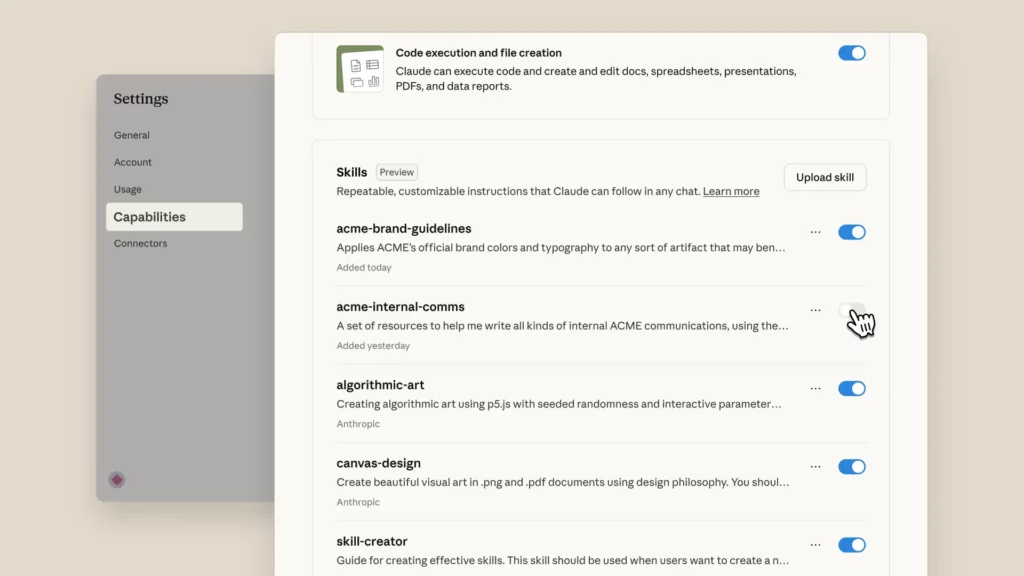
Claude Skills are like plug‑ins for your AI assistant. Each skill is a folder containing instructions, examples, scripts, and resources that are only loaded when needed. According to Anthropic, skills are composable (they stack together so you can combine multiple skills in one session), portable (they use the same format across Claude apps and API), efficient (they only load the data that’s needed, making responses fast), and powerful (they can include executable code to manipulate data or interact with APIs). In practice, this means you can ask Claude to “summarize our Google Analytics report and generate three action items for next week” and, if you’ve installed the right skills, it will seamlessly fetch the report, perform the analysis, and output insights using your brand tone (www.anthropic.com).
Anthropic’s library already includes skills for reading and generating Excel spreadsheets with formulas, creating PowerPoint presentations, writing Word documents, and filling out PDFs (www.anthropic.com). You can also build custom skills using simple configuration files that define the tasks, data requirements, and outputs. Because skills are only invoked when triggered, they don’t bloat your model’s context window; you can load dozens of skills without slowing down interactions.
Why Should Digital Marketers Care?
Digital marketing involves dozens of repetitive processes: researching keywords, drafting social media posts, analyzing performance metrics, creating landing pages, personalizing email sequences, and more. Each of these tasks follows patterns that an AI can learn. Skills let you encode those patterns once and reuse them across campaigns. Here are a few reasons to pay attention:
- Consistency across touchpoints: With a skill that encapsulates your brand voice and style guide, you ensure every social post, ad, or blog outline stays on message.
- Time savings: Automating research, drafting, and analysis frees your team to focus on strategy and creativity. According to industry surveys, marketers spend up to 30 % of their time on repetitive tasks; skills can slash that by half.
- Rapid experimentation: Want to A/B test 10 variations of a headline? A skill can generate them instantly and even predict which will perform best based on historical data.
- Cross‑channel coordination: Because skills are portable, you can call the same keyword research or analytics interpretation skill from the Claude chat interface, your CRM integration, or your marketing automation platform.
- Lower learning curve: You don’t need to be a developer to create simple skills. A YAML or JSON configuration file with instructions and sample prompts is often enough. For more complex workflows, you can embed Python scripts or API calls.
11 Essential Claude Skills Templates for Digital Marketers
Below are eleven skill templates that cover the most common marketing tasks. Treat them as inspiration; you can customize them with your own brand guidelines, metrics, or creative constraints.
- SEO Keyword Explorer – Input a seed topic and this skill scrapes search intent, generates a list of long-tail keywords, estimates difficulty, and suggests content angles. Integrate with tools like Google Keyword Planner or Ahrefs via API keys for up-to-date data.
- Blog Outline Generator – Provide a topic and audience, and the skill drafts an outline with headings, subheadings, and keyword clusters. It includes placeholders for stats and quotes, and recommends internal and external links to maximize SEO.
- A/B Headline Crafter – Feed it your product or article summary and the desired tone (e.g., curiosity, urgency), and the skill outputs multiple headline variations optimized for click-through rates. It can incorporate power words, numbers, and emotional triggers.
- Social Media Sentiment Analyzer – Monitor brand sentiment across social platforms by feeding posts, reviews, and comments into this skill. It uses natural language processing to score sentiment, tag emerging issues, and suggest quick responses. The skill can cross‑reference your brand tone guidelines to ensure any reply is on message.
- Social Data Cruncher – For community managers drowning in metrics, this skill template aggregates data from networks like Twitter/X, LinkedIn, and TikTok. It charts follower growth, engagement rates, and top‑performing posts, providing plain‑language insights into why certain content resonated and how to replicate success.
- Competitive Intelligence Scanner – Stay ahead of rivals by analyzing competitor blogs, product pages, ad campaigns, and social posts. This skill scrapes publicly available content and identifies patterns, trending keywords, and gaps your brand could exploit. It can automatically generate a SWOT analysis or battle card for your sales teams.
- Automated Report Builder – Imagine being able to turn raw marketing data into executive‑ready summaries with zero manual formatting. This skill template pulls metrics from analytics tools, crunches numbers, and automatically generates polished reports complete with charts, bullet points and plain‑English commentary. You can schedule it to email a weekly performance summary to stakeholders or embed it in a dashboard. By automating this thankless chore you not only save hours but ensure that your team looks at the same objective picture instead of cobbled‑together spreadsheets.
- Website Personalization Concierge – A great marketer knows that tiny on‑page tweaks can drive huge uplifts in dwell time and conversion. This skill template connects to your CMS, CRM, and experimentation tools to deliver dynamic recommendations for site personalization. It analyzes visitor segments, predicts intent and suggests targeted banners, pop‑ups, product modules or content blocks to show each audience slice. Because Claude can run those suggestions through your brand style guide skill, you avoid off‑brand moments. The result is a personal shopper experience across your digital properties without constant manual A/B tests.
- AI‑Powered Outreach Scheduler – Cold outreach is still vital, but batching emails at random times isn’t effective. This skill template uses machine learning to detect your prospects’ highest‑engagement windows across channels. It syncs with your CRM, loads contact data, and crafts personalized outreach messages using your tone‑of‑voice instructions. It then schedules those messages to send when recipients are most likely to read and reply, dramatically improving open and reply rates. The skill also logs results back to your CRM so you can iterate.
- Community Engagement Moderator – If you operate online communities or manage brand forums, moderating comments and questions can eat up an afternoon. This skill template reviews posts for sentiment, spam, or policy violations and drafts thoughtful responses or escalation notes. It flags negative sentiment for human follow‑up and highlights opportunities for deeper engagement. Over time it learns your moderation guidelines and brand voice, freeing your community manager to focus on building relationships instead of policing.
- Real‑Time Trend Radar – Timing is everything when you want to ride a trend rather than react after it peaks. This skill template plugs into social‑listening platforms, Google Trends, competitor blogs and news feeds to surface emergent topics rele
How to Build Your Own Claude Skill
While the templates above are ready for action, the true superpower of the Claude platform is the ability to roll your own skill tailored to your brand’s goals. Building a skill is less like coding an app and more like packaging your best practices, instructions, and resources into a reusable container. Here’s a simple workflow:
Clarify the job to be done. Define the narrow marketing problem you want the skill to handle. Is it summarizing competitor newsletters? Drafting responses to support tickets? Creating article briefs? The more specific the job, the more effective your skill will be.
Assemble your instructions. Write concise guidelines that tell Claude how to approach tasks. You might include your brand’s tone (casual yet authoritative), formatting rules (use H2 and bullet lists, add keywords naturally), or platform‑specific constraints (no fluff phrases, keep intros under 70 words).
Gather resources and scripts. Skills can include Python scripts, sample files, templates, and other assets. For a reporting skill you might include a Jupyter notebook for data transformation; for a writing assistant you might attach a list of preferred power words. If you need to call external APIs you can link a connector skill.
Test incrementally. Upload your skill to Claude’s dashboard (or via the API) and run it on small test tasks. Watch for hallucinations, length issues and style drift. Refine your instructions and assets accordingly. Because skills are composable you can chain them together—e.g., run a research skill then feed its output into your writing skill to generate polished articles.
Share and iterate. Once you’re happy with the results, share the skill with your team or across your brand’s Claude instances. Gather feedback and usage data to improve it. The portable nature of skills means you can move them between chat interfaces, API calls and even spreadsheets without rewriting anything.
With these steps you can transform proprietary processes into repeatable AI shortcuts that scale beyond any single marketer.
Frequently Asked Questions
u003cstrongu003eWhat exactly is a Claude skill?u003c/strongu003e
A skill is a self‑contained package of instructions, code and assets that tells Claude how to perform a specialized task. Anthropic describes them as folders loaded only when needed (u003ca href=u0022https://www.anthropic.com/news/skills#:~:text=apps%2C%20Claude%20Code%2C%20and%20our,expertise%2C%20making%20Claude%20a%20specialistu0022 target=u0022_blanku0022 rel=u0022noreferrer noopeneru0022u003ewww.anthropic.comu003c/au003e), so your AI can become an SEO assistant one moment and a report writer the next without juggling prompts.
u003cstrongu003eAre skills available to all users?u003c/strongu003e
As of late 2025, Skills are rolling out across the Claude API and consumer chat apps. They’re accessible to paid and enterprise users, and some pre‑built skills are free. Developers can create custom skills for internal use, while marketplaces may emerge for sharing and selling high‑quality skills.
u003cstrongu003eDo I need to know how to code?u003c/strongu003e
Not necessarily. Many skill templates rely on plain‑English instructions and simple assets. However, if you want to integrate external tools or run complex computations, you can include Python scripts or connectors. The platform is designed to support low‑code workflows while remaining powerful for technical teams.
u003cstrongu003eHow do skills protect my data?u003c/strongu003e
Skills are loaded only when invoked and can be built to minimize data sharing. You decide what resources the skill accesses; for example, a reporting skill might only read anonymized analytics exports. Anthropic emphasizes that their architecture loads only the necessary resources at runtime (u003ca href=u0022https://www.anthropic.com/news/skills#:~:text=apps%2C%20Claude%20Code%2C%20and%20our,expertise%2C%20making%20Claude%20a%20specialistu0022 target=u0022_blanku0022 rel=u0022noreferrer noopeneru0022u003ewww.anthropic.comu003c/au003e), reducing risk. Always audit your skill instructions and connectors for compliance with privacy policies.
u003cstrongu003eCan I combine multiple skills together?u003c/strongu003e
Yes! Skills are composable (u003ca href=u0022https://www.anthropic.com/news/skills#:~:text=apps%2C%20Claude%20Code%2C%20and%20our,expertise%2C%20making%20Claude%20a%20specialistu0022 target=u0022_blanku0022 rel=u0022noreferrer noopeneru0022u003ewww.anthropic.comu003c/au003e), meaning you can chain them to build sophisticated workflows. You might run a research skill, then pass its output to a summarization skill, and finally into a visual design skill that drafts infographics. Because each skill follows the same portable format, they work seamlessly together across Claude apps and the API.
Conclusion
Digital marketing is evolving faster than any single human team can keep up with. Tools like Claude’s skills templates offer a pragmatic way to stay ahead by turning your knowledge and best practices into automated assistants. By deploying ready‑made templates for SEO research, sentiment analysis, social media data crunching and beyond, you free yourself to focus on strategy and creativity. And by building your own skills, you codify your unique processes into shareable assets that scale across campaigns and teams.
The broader ecosystem is moving toward agentic, AI‑powered workflows. OpenAI’s AgentKit aims to help businesses build agents that automate tasks end to end, while the Agentic Commerce Protocol promises frictionless buying experiences (openai.com, www.eesel.ai). Anthropic’s Skills complement this trend by giving individuals and organizations granular control over specialized tasks (www.anthropic.com). Early movers who embrace these tools will not only save time but capture mindshare in an increasingly AI‑mediated market.
Remember that the best skills are built with empathy for your audience and humility about what the AI should and shouldn’t do. Start small, iterate relentlessly, and treat skills as living documentation of your evolving marketing playbook. When used thoughtfully, Claude’s skills templates can help digital marketers achieve more with less, turning AI from a novelty into an indispensable partner in growth.vant to your niche. It provides short digest summaries, potential angles for content, and an urgency score so you can decide whether to act immediately or bookmark for later. Because it’s modular you can combine it with your content generator skill to spin up a quick post or campaign while the conversation is hot.